
It's usually time to repipe a house when leaks, rusty water, or weak pressure begin appearing in several areas around the home. Your pipes' age and material are also worth weighing, along with where the problems show up.
Signs you need to repipe
Trouble that shows up all over the house is the biggest clue. Fuse Service says a repipe usually makes sense once leaks, discolored water, or low pressure appear in several places rather than one.
Repair bills that keep coming back are another clue. In a home on a slab, the pipes run under or inside the concrete floor. Each slab leak repair runs about $2,000 to $4,000, and a handful of them can approach the price of repiping the whole house.
Pipe age matters as well. Galvanized steel holds up for roughly 40 to 50 years and was a standard material in homes built before the 1960s. These days it's generally replaced with PEX, copper, or CPVC.
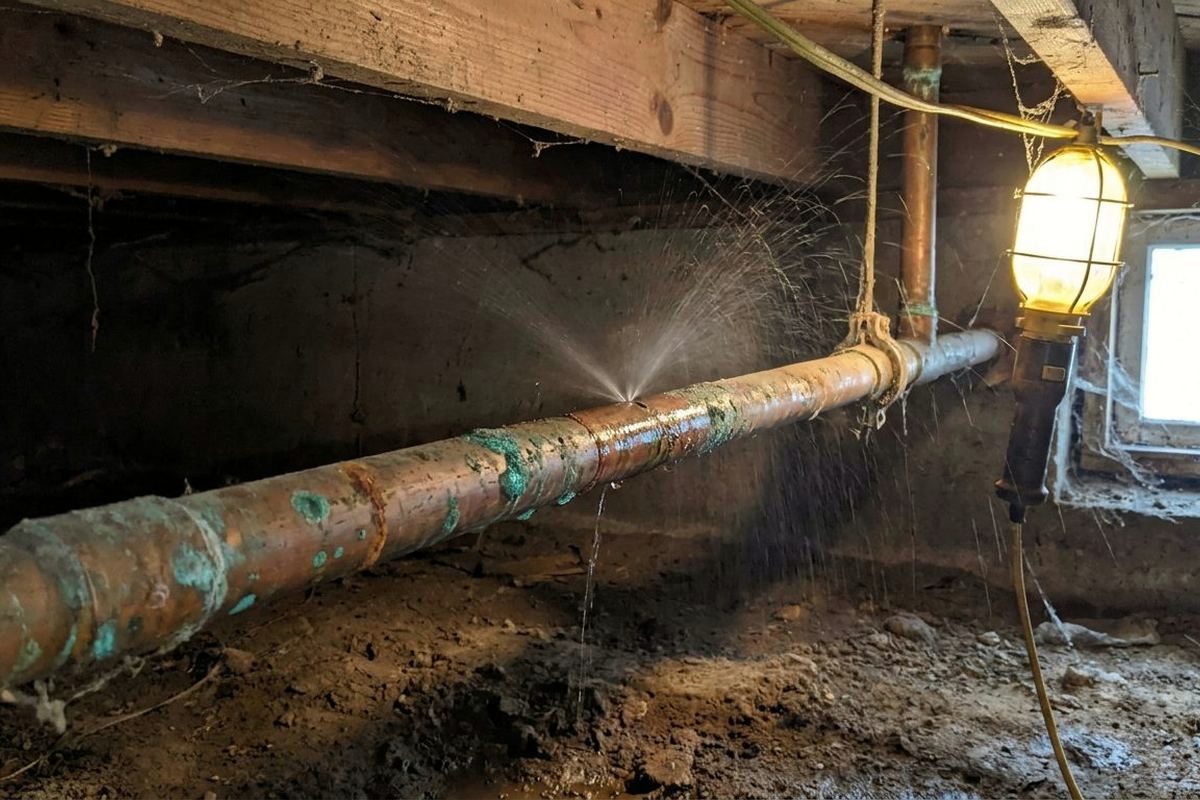
Pipe materials that tend to fail
Polybutylene is a plastic pipe that went into about 10 million homes between 1978 and 1995, according to InterNACHI. Houses plumbed during that stretch are worth a look.
Kitec ran from 1995 to 2007. Over time, Kitec lines can develop blockages. Pressure then builds inside the pipes until they burst or crack.
Will a repipe fix discolored water?
Yes, if rust in the pipes is what's causing it. Angi explains that rust can tint your water any of several rusty shades, and it can make the water smell like rotten eggs.
If colored water comes from taps in several rooms, especially when leaks or weak flow come with it, it may be time for new pipes throughout the house.
Will a repipe fix low water pressure?
Low pressure in several parts of the house is one sign that a repipe may be worth considering.
If the pressure is weak at every tap and you're also seeing rust or leaks, new pipes are likely a better buy than more repairs. They can last 50 to 100 years.
Is repiping worth it before you sell?
In Houston, buyers often push the cost of replacing polybutylene pipes onto the seller, according to Geek Powered Studios.
If your house has polybutylene, Kitec, or aging galvanized steel, it can help to know a rough repipe cost before you negotiate.
Repipe cost by house size
The price of a repipe depends on how many bathrooms you have and how big the house is, not how many bedrooms. A crawl space is the shallow open area beneath a raised floor. These calculator estimates are for a single-story home with a crawl space, using PEX, a flexible plastic water pipe, and the typical US plumber rate of $34.70 an hour.
| Number of bathrooms | Square footage | Rough cost | Days of work |
|---|---|---|---|
| One bath | 1,200 sq ft | roughly $4,100 to $7,700 | 2 to 3 |
| Two baths | 1,800 sq ft | roughly $6,400 to $11,800 | 2 to 3 |
| Three baths | 2,400 sq ft | roughly $7,500 to $14,400 | 3 to 4 |
| Four or more | 3,200 sq ft | roughly $10,600 to $21,200 | 4 to 5 |
Put that same 1,800 sq ft, 2-bath house on a slab and the price climbs to roughly $8,300 to $16,300. Spread over 2 floors with a crawl space below, you're looking at around $7,000 to $13,200 over 2 to 4 days of work. These are only estimates. For a fixed price, call our line and we'll connect you, free, with a repipe company near you that will look at the house first.
Questions people often ask
What's the price gap between copper and PEX?
On a 2,000 sq ft, 2-bath home above a crawl space, copper lands around $9,800 to $19,500. The identical job in PEX runs about $6,800 to $12,500. Copper also stretches the timeline on an 1,800 sq ft home to about 3 to 5 days, instead of the usual 2 to 3.
Are costs different in each state?
Yes. Roughly 70% of the bill goes to labor, and plumbers earn different wages from state to state, so the same house costs more in some places than others. The table prices an identical 1,800 sq ft, 2-bath, single-story PEX home over a crawl space, drawing on Bureau of Labor Statistics wage data from May 2025.
| State | Plumber hourly pay | Rough cost |
|---|---|---|
| Florida | $26.94 | roughly $5,400 to $9,900 |
| Texas | $29.22 | roughly $5,700 to $10,500 |
| Arizona | $32.66 | roughly $6,100 to $11,300 |
| California | $39.58 | roughly $7,000 to $13,000 |
| New York | $40.29 | roughly $7,100 to $13,100 |
| Washington | $42.69 | roughly $7,400 to $13,700 |
How do I find out which pipes my house has?
Look at a pipe you can reach, such as the one beneath a sink or inside the crawl space, and note its color and how it feels. PEX is bendy plastic, typically red for hot lines and blue for cold. CPVC is stiff plastic in a cream or tan shade, and copper is a metallic line held together with soldered joints.