
If your pipes are leaking or just old and you need repipe specialists in Austin, the first thing you want is a fair price. For the very same job, quotes from different companies can swing by $2,000 to $5,000. So protect yourself and lock in a firm, written price up front. Call now and we'll connect you, free, with a repipe company that works in Austin. They'll look at your house and then give you a fixed price, so you know your number before you commit.
Repipe cost in Austin
Roughly 70 % of a repipe bill goes to labor. Austin plumbers make about $30.65 an hour, roughly 12 % under the $34.70 the average US plumber earns. Because labor is most of the bill, that lower wage means an Austin repipe usually costs a little less than the national average.
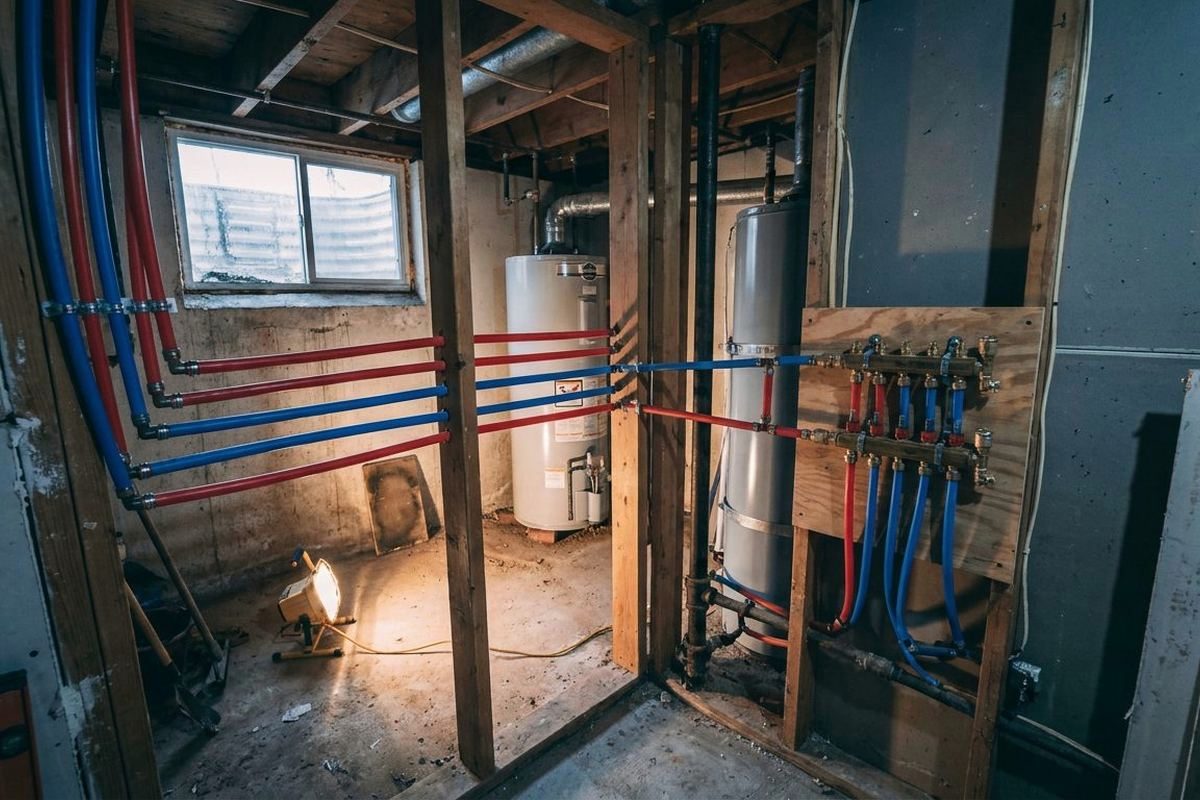
PEX is the pipe used in most of these estimates. It's a flexible plastic water pipe, with red lines carrying the hot supply and blue lines the cold. Your floor type matters as well. A crawl space is the shallow, open gap between the ground and a raised floor. A slab, by contrast, is solid concrete sitting directly on the soil, with pipes either beneath or embedded in it.
These are this site's estimates for homes in the Austin area, not quotes.
| Home | Rough cost |
|---|---|
| One-story, 2-bath home of about 1,800 sq ft, PEX over a crawl space | $5,900 to $10,800 |
| That same home on a slab foundation | $7,600 to $15,000 |
| That same home piped in copper rather than PEX | $8,600 to $17,300 |
| Two-story, 3-bath home of about 2,400 sq ft, PEX over a crawl space | $7,500 to $14,800 |
Working through concrete is harder, so slab jobs run higher. It can add 25 to 50 % to the labor part of the bill. Once a company walks through your home, it can tell you where your project lands in that range.
What should a specialist's quote cover?
One repipe specialist says repipes are all it does. That company says its price covers wall repairs, permits, the inspection, and a warranty for life.
When you get a written price, make sure it spells out the permit, the drywall repair, and the final inspection. It should also state the length of the warranty.
Checking the plumber's license
In Texas, the Texas State Board of Plumbing Examiners is the agency that licenses plumbers and plumbing contractors. Its own guidance to homeowners is simple: never hire anyone without a license. Get the license number up front and verify it before letting anyone open up your walls.
Getting a fixed price for your house
Bathrooms, home size, the floor under it, the type of pipe, and a second story all push the number up or down. Because of that, a fixed price can only come after someone sees the house.
The process goes like this:
- You call, and the site links you to a repipe company serving Austin.
- That company visits and inspects your pipes, floors, and bathrooms.
- It hands you a fixed price for your particular home.
Call now. This site charges you nothing for the call, and you get your fixed price before you commit to anything.
Repipe numbers for Austin
| Plumber wage in the Austin area | $30.65 an hour |
| Plumbers working in the area | 5,260 |
| Texas average | $29.22 an hour |
| 2-bath PEX repipe, crawl space | $5,900 to $10,800 |
| 2-bath PEX repipe, slab | $7,600 to $15,000 |
Wages from the Bureau of Labor Statistics wage survey for plumbers (Austin-Round Rock-San Marcos, TX); prices from this site's calculator.
Repipe specialists in other cities
Common questions
Is it okay to be home while the repipe happens?
Yes. Most families stay in the house the whole time the work is going on.
How long does a repipe take?
For a single-story, 2-bath home of about 1,800 sq ft in PEX over a crawl space, expect roughly 2 to 3 days of work. If that same house is done in copper, plan on a longer job of roughly 3 to 5 days.
Do bedrooms affect what I'll pay?
Bedrooms don't drive the cost. Bathrooms and square footage do. A home with 3 bedrooms typically has 2 bathrooms, so you'd pay about what any similar-sized 2-bath home would.
How can I tell what pipes I have?
The pipe identifier on this site can name 8 different pipe types based on how they look and how they feel to the touch: polybutylene, Kitec, galvanized steel, copper, PEX, CPVC, cast iron, and Orangeburg. To give a couple of examples, CPVC is rigid plastic pipe in a cream or tan color, while copper is metal pipe joined with solder.