
Your cast iron pipe replacement cost comes down to two things: how much of it needs replacing, and where it sits in your home. If it's a short piece in an open spot, you might spend a few hundred dollars. If it runs under a concrete floor, the bill can reach many thousands.
Where in a home will you find cast iron?
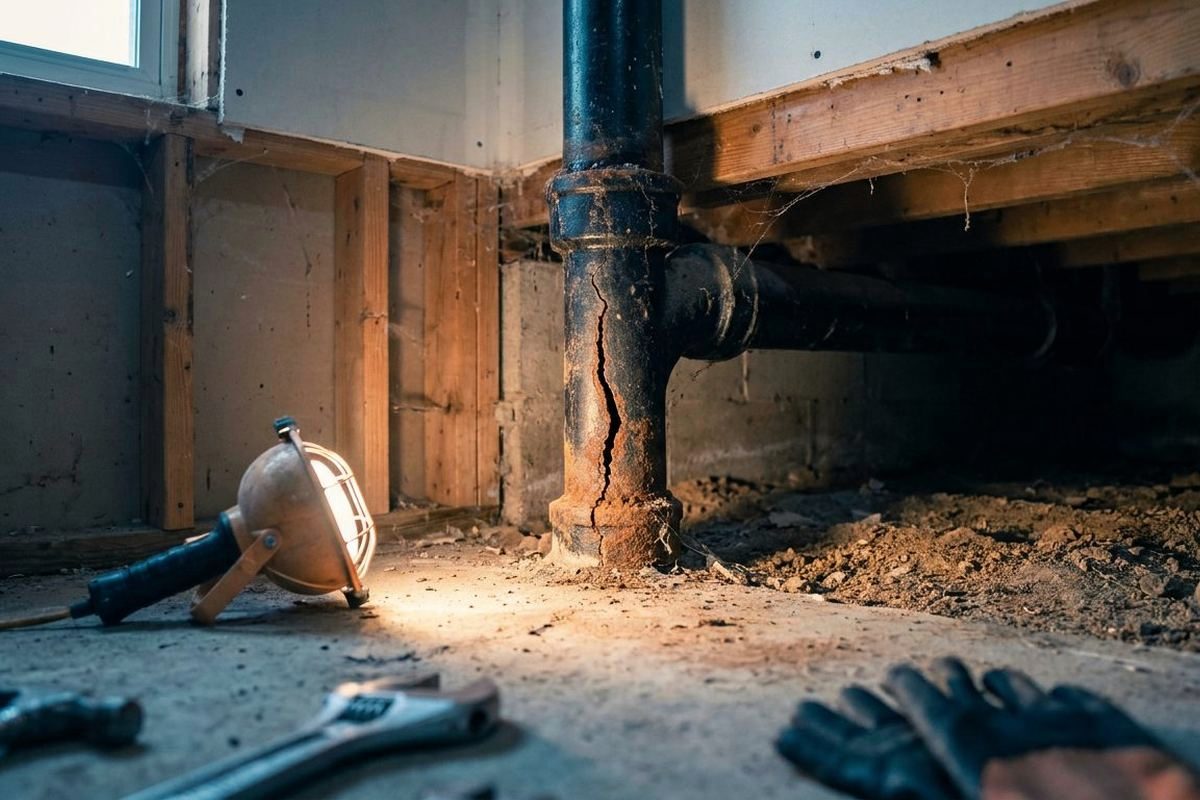
Houses built before the 1970s are the ones most likely to have cast iron drains. You'll typically spot it in two places: the big black vertical drain stack down in the basement or crawl space, plus the drain line beneath the slab.
That drain stack is the tall, fat pipe that takes waste from your toilets, sinks, and showers and sends it out of the house. A slab is just a concrete floor poured directly on the ground, with the pipes tucked either below it or within it.
What cast iron pipe costs by length?
With installation figured in, expect to pay roughly $12.50 to $30 per foot to swap out cast iron, per Angi's cast iron pipe cost guide. More feet means a bigger bill.
| How much pipe | Price with installation |
|---|---|
| 10 ft | $125 to $300 |
| 30 ft | $375 to $900 |
| 60 ft | $750 to $1,800 |
Those figures cover only the pipe work itself. Where the pipe happens to run can push the final total way up or down.
Prices by pipe location
Length isn't always the biggest factor. Location often matters more. Below are the ranges Angi lists for pipes in different spots around a house.
| Where it sits | What it costs |
|---|---|
| A 30-foot stretch | $375 to $900 |
| Basement overhead sewer line | $8,000 to $10,000 |
| Beneath a slab | $3,000 to $20,000 |
Overhead sewer lines run high along a basement ceiling or wall instead of under the floor. As for slab work, the range is so wide that 2 houses facing the identical problem can end up with quotes that differ wildly.
What makes cast iron fail?
Over the years, cast iron rusts and cracks, and the trouble tends to start on the pipe's underside, where water collects. Angi points out that cast iron isn't common in newer homes, since rust and corrosion, clogs, freezing and thawing, and plain breakage all wear it down.
Since the damage begins inside, along the bottom, a cast iron pipe can look fine from the outside while being quite worn.
Repiping the whole system or fixing just the bad spots
There's no rule that all your cast iron has to go at once. Most people take the wait-and-see route: keep an eye on the pipe and replace pieces as they crack, rust through, or clog again and again.
Fixing just the failing sections keeps the cost in line with the per-foot rate for a small job. But once problems start showing up all over, replacing a larger stretch may make more sense than paying for repair after repair.
A repipe company will quote you a fixed price once it's seen the house, because pipe length and location are hard to judge without looking.
Cast iron at a glance
- Used: older homes, mostly before the 1970s
- Where you'll see it: The big black drain stack in the basement or crawl space, and the drain under the slab.
- How it fails: It rusts and cracks, mostly along the bottom where water sits.
- What to do: Watch it.
Details from angi.com.
Questions people ask
What's the average cost to replace cast iron pipes?
Angi puts the national average at about $650, per their figures. That figure mixes together all sorts of jobs, so a minor repair might come in far under it, and a job under concrete might run far over.
Will homeowners insurance pay to replace cast iron pipes?
Every policy is different. Angi recommends checking with the company that holds your homeowners policy, and with your HOA if you belong to one, to find out whether they'll pay for damage tied to your cast iron pipes. An HOA is the group that manages certain neighborhoods and condo buildings.
Is it wise to replace cast iron sewer pipes in an older house?
Cast iron drains hold up for about 50 to 75 years. If your house went up before the 1970s, the pipes could be at or beyond that point. Age alone doesn't mean a replacement is due, but it's a fair reason to watch for cracks, rust, and clogs that won't stay away.