
A pipe's color, whether it's metal or plastic, and how the pieces connect can help you tell what pipes you have. Once you've named the type, you'll also know if it's probably okay or if it needs replacing.
Good spots to check your pipes
The best look at a pipe is where it exits a wall or floor. Try the sink cabinets in the kitchen and bath, beside the water heater, across the basement ceiling, and at the water meter.
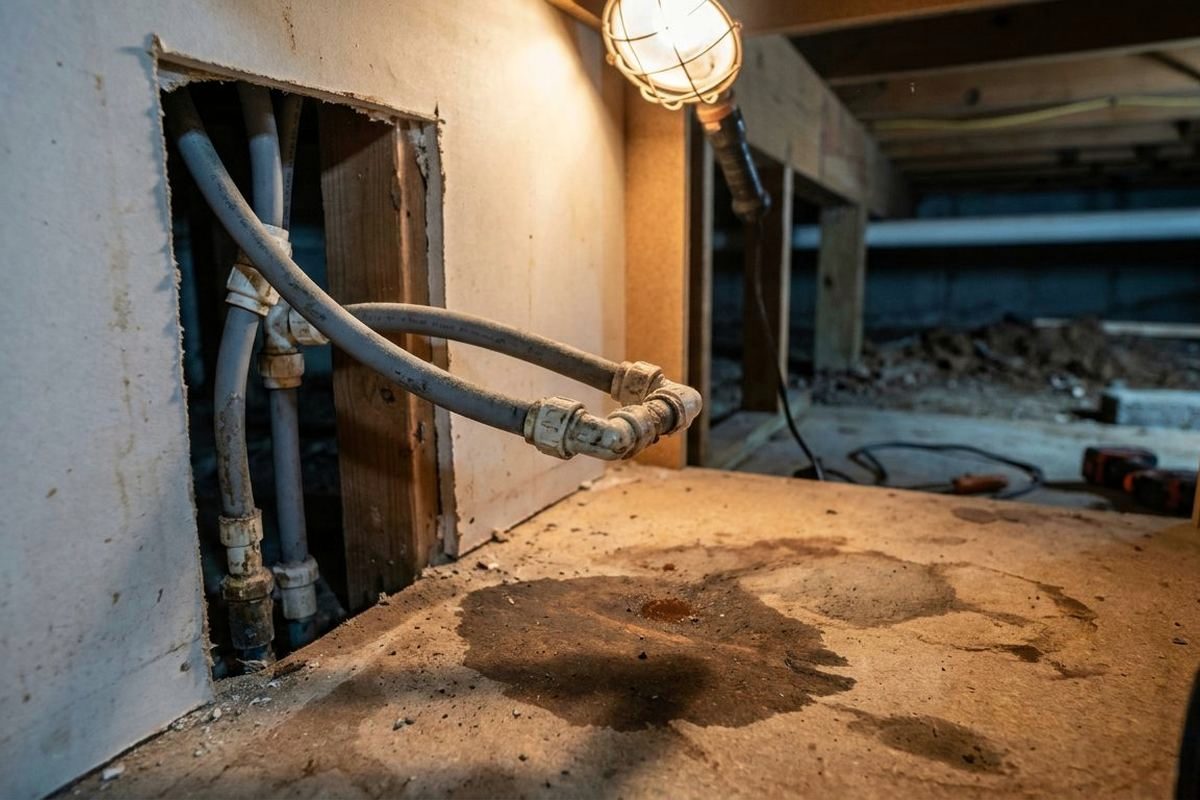
Fittings are those short pieces that hold two pipes together. For Kitec, look for "Kitec" or "KTC" on the fittings, and for polybutylene, look for "PB2110" stamped on the pipe.
Pipe types, when they were used, and what to do
| Pipe | Looks like | Years in use | Advice |
|---|---|---|---|
| Polybutylene | Gray plastic that bends | 1978–1995 | Replace |
| Kitec | Orange and blue, joined by brass fittings | 1995–2007 | Replace |
| Galvanized steel | Dull gray metal, threaded joints | Up to the 1960s | Plan to replace |
| Copper | Copper-colored metal, soldered joints | 1960s onward | Usually fine, but replace it if pinhole leaks keep coming back |
| PEX | Red and blue, bendy, held by metal rings | 1990s onward | Fine |
| CPVC | Stiff plastic in cream or tan, with glued seams | 1960s onward | Usually fine |
| Cast iron | Heavy black pipe for drains | Mostly pre-1970 | Keep an eye on it |
| Orangeburg | Outdoor sewer pipe made of black tar paper | 1945–1972 | Replace |
How to spot polybutylene pipes
Polybutylene is gray plastic that bends easily, and it went into roughly 10 million homes between 1978 and 1995. Lots of sections carry the stamp PB2110, so run your eyes along the pipe and look for it.
You'll usually see it under sinks, next to the water heater, running overhead in the basement, and near the water meter. The chemicals used to disinfect tap water slowly eat at the plastic, and tiny cracks form from the inside. Since a leak can start without any warning, it's best to replace it.
How to spot Kitec
Kitec pipes were used from 1995 to 2007. The cold water runs through blue pipe and the hot through orange. Look by the water heater and the main shutoff valve, and read the fittings you can see for the words Kitec or KTC.
Those brass parts break down and clog, and the pipe can burst, most often on the hot side. Kitec was recalled in 2005, so if you find it, plan to replace it before a fitting fails.
Lead service lines
Your service line is the one running from the street to your house. Around 4 million lead service lines are still in use in the US. You can't tell what your service line is made of from the pipes under your sinks, but your water system keeps a record of service line materials, so ask it whether yours is lead.
Galvanized steel, cast iron and Orangeburg
Galvanized steel is dull gray metal with threaded joints, and a magnet will cling to it. Homes built before the 1960s often have it, and its working life runs roughly 40 to 50 years. Over time the zinc coating wears away and the steel rusts from the inside, so the pipe narrows, your water pressure drops, and the water can come out stained.
Cast iron is that big black drain stack you'll see in the basement or crawl space, the low open area under a raised floor. Expect 50 to 75 years out of it. Rust and cracks tend to show up low on the pipe, since that's where water collects. Swap out any section that cracks, rusts through, or keeps clogging.
Orangeburg is sewer pipe built from tar-soaked paper, buried in the yard running from your home to the street. A camera inspection reveals it. The paper draws in water, goes soft, and flattens into an oval, and then roots work their way in, so it should be replaced.
Common questions
Does insurance cover polybutylene replacement?
Most likely not. Insurers mostly consider polybutylene a known defect and treat replacement as the homeowner's job.
How much does a PEX repipe cost?
Take a one-story, 1,800 sq ft home with 2 bathrooms sitting over a crawl space: expect roughly $6,400 to $11,800 with average US labor rates, over 2 to 3 days of work. On a concrete slab, that same house runs about $8,300 to $16,300. Treat these as rough figures; the repipe company sets a firm price once it's seen the house.
| Crawl-space house, one story, plumbed in PEX | Rough cost |
|---|---|
| 1,200 square feet, single bath | Roughly $4,100–$7,700 |
| 1,800 square feet, two baths | Roughly $6,400–$11,800 |
| 2,400 square feet, three baths | Roughly $7,500–$14,400 |
Why is PEX used for most repipes?
It can't rust or corrode, and failures are rare. It's also the most common choice for new homes, used in about 60% of new home construction.
Is old CPVC something to worry about?
Usually not. After a couple decades of heating and cooling, though, it may turn brittle and crack at bends or where it's been bumped.